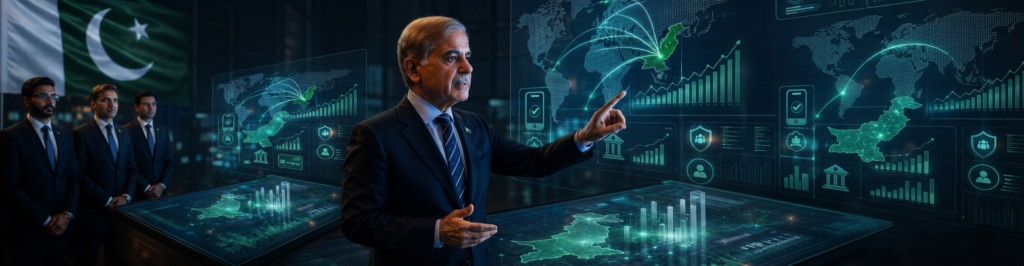
Pakistan’s remittance inflows just hit a record high and the Prime Minister wants all of it flowing digitally. Chairing a review meeting on promoting a cashless economy in Islamabad, Prime Minister Shehbaz Sharif directed authorities to ensure 100% of overseas remittances are received through digital channels, alongside stronger nationwide campaigns to push merchants toward QR code-based payments.
Table of Contents
Key Takeaways
- Directive: All overseas remittances to be routed through digital channels, up from the current 92%
- Record remittances: Workers’ remittances hit $41.6 billion in FY2025-26, up roughly 9% year-on-year
- QR merchant growth: Merchants accepting digital/QR payments rose 300% in a year, from roughly 500,000 to 2.003 million
- Mobile banking users: Grew from 95 million to 137 million
- NADRA digitization: 99% of payments to the National Database and Registration Authority are now digital
- Cash transaction share: Dropped sharply from 71% to just 1%
- Total digital transactions: 11.9 billion recorded between July 2025 and June 2026
- BISP disbursements: Now fully shifted to digital wallets
- Roshan Digital Account: Framework expanded to include foreign nationals and investors
- Independent validation: A third-party review of the cashless economy initiative is underway, with findings due in November 2026
What the Prime Minister Directed
At a meeting focused specifically on promoting digital payments and a cashless economy, PM Shehbaz Sharif instructed relevant authorities to ensure that all remittances sent by overseas Pakistanis are processed through digital channels a move up from the current 92% digital share. He also directed that public awareness campaigns be intensified to encourage merchants and traders to adopt QR code-based payment systems more widely, and called on banks and financial institutions to take a more proactive role in accelerating the country’s shift toward cashless transactions.
The Prime Minister linked the push directly to broader economic goals, stating that full digitization would improve transparency, efficiency, and financial inclusion while supporting sustainable economic growth.
The Numbers Behind the Push
Officials briefing the meeting laid out a year of rapid digital payments growth:
- Remittances: 92% of overseas remittances during the past year (July 2025–June 2026) were already received digitally, against a backdrop of workers’ remittances reaching a record $41.6 billion for FY2025-26 an increase of roughly 9% over the previous year, according to Adviser to the Finance Minister Khurram Schehzad. June 2026 alone contributed $3.5 billion of that total.
- Merchant adoption: The number of merchants accepting digital, QR code-based payments surged 300% between June 2025 and June 2026, reaching 2.003 million active merchants.
- Mobile banking: The number of mobile banking application users climbed from 95 million to 137 million over the same period a jump the Prime Minister described as a significant achievement.
- Government service digitization: 99% of payments made to NADRA are now processed digitally, while overall cash transaction share across the reviewed metrics fell from 71% to just 1%.
- Total activity: 11.9 billion digital transactions were recorded nationwide between July 2025 and June 2026.
Remittances in Context: A Historic Year
The push for full digitization comes directly on the heels of Pakistan’s best-ever year for remittance inflows. Workers’ remittances reached $41.6 billion in FY2025-26 the highest annual figure in the country’s history — building on a multi-year growth trend that saw inflows rise from $27.3 billion in FY2023, to $30.3 billion in FY2024, to $38.3 billion in FY2025, and now to this year’s record.
Khurram Schehzad framed the milestone as reflecting overseas Pakistanis’ continued confidence in government policy, along with improving macroeconomic fundamentals, stronger foreign exchange buffers, and greater external sector resilience. PM Shehbaz separately praised overseas Pakistanis directly, calling them a valuable national asset and noting the entire nation’s pride in their contribution.
Other Digital Initiatives Highlighted at the Meeting
BISP goes fully digital. The Prime Minister praised the transition of Benazir Income Support Programme payments to a fully digital wallet-based system, describing it as more transparent, faster, and more convenient for beneficiaries compared to previous cash-based disbursement methods.
Roshan Digital Account expansion. The government has broadened the Roshan Digital Account framework to allow participation by foreign nationals and investors, extending access to Pakistan’s digital financial ecosystem beyond overseas Pakistanis alone.
Bank-level targets through Raast. The Pakistan Banks’ Association has assigned specific digital payment promotion targets to its member banks, including continued expansion of the Raast instant payment system.
Independent validation underway. An independent third-party validation of the entire cashless economy initiative is currently in progress, with a final report and recommendations expected to be presented in November 2026 giving the government an external benchmark against which to measure this year’s progress.
Why This Matters
- It targets the single largest remaining gap in digital payments adoption. With most domestic metrics (NADRA payments, cash transaction share, merchant QR adoption) already showing high digital penetration, remittances at 92% represent one of the clearest remaining opportunities to close the gap to fully digital.
- It reinforces remittances’ outsized role in Pakistan’s economy. At $41.6 billion, remittances remain Pakistan’s largest source of external financing larger than most other single external inflows making their full digitization a matter of macroeconomic transparency and efficiency, not just consumer convenience.
- It builds on measurable, year-over-year momentum. The 300% jump in QR-accepting merchants and the growth from 95 million to 137 million mobile banking users show this isn’t a fresh policy push starting from zero, but a continuation of a fast-moving existing trend.
- It connects to a broader digital governance agenda. This directive lands alongside other major 2026 digital finance initiatives including the InvestPak Portal for government securities and SECP’s IBAN-based KYC verification reflecting a consistent, government-wide push toward digitizing Pakistan’s financial infrastructure.
- It sets up an accountability checkpoint. With independent validation results due in November 2026, this year’s ambitious targets including the 100% remittance digitization goal will be measured against external verification rather than government reporting alone.
Frequently Asked Questions
What did PM Shehbaz Sharif direct regarding remittances?
He directed authorities to ensure that 100% of overseas remittances are received through digital channels, up from the current 92%.
How much did Pakistan receive in remittances during FY2025-26?
A record $41.6 billion, an increase of roughly 9% over the previous fiscal year.
How many merchants now accept digital/QR payments in Pakistan?
2.003 million, following 300% growth between June 2025 and June 2026.
How many mobile banking users does Pakistan have?
137 million, up from 95 million a year earlier.
What share of Pakistan’s payments are now digital versus cash?
Cash transaction share has dropped from 71% to just 1% across the metrics reviewed, while 99% of NADRA payments are now processed digitally.
Has the Roshan Digital Account changed?
Yes, its framework has been expanded to allow participation by foreign nationals and investors, broadening access beyond overseas Pakistanis.
When will the cashless economy initiative be independently reviewed?
An independent third-party validation is underway, with a final report and recommendations due in November 2026