
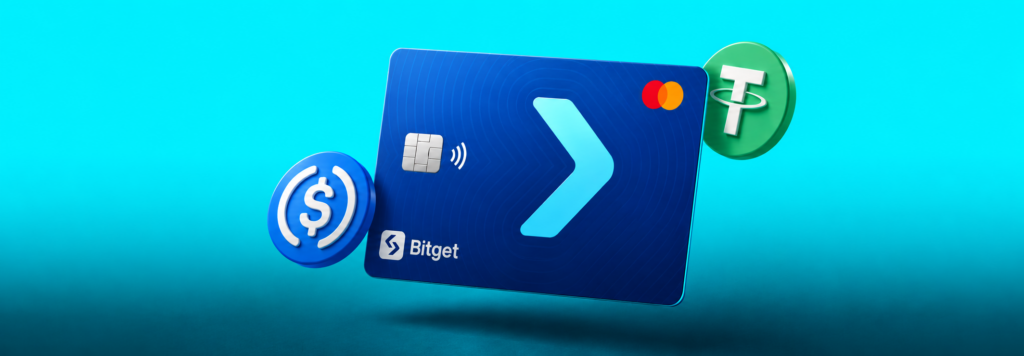
Self-custodial crypto just got a lot more spendable in South Asia. Bitget Wallet has officially launched its Bitget Wallet Card in the region the product’s first-ever rollout in South Asia letting users top up with stablecoins and spend directly at hundreds of millions of merchant locations worldwide, all without giving up control of their underlying wallet.
Key Takeaways
- What launched: Bitget Wallet Card, in South Asia, for the first time
- How it works: Users top up the card with USDT or USDC from their self-custodial wallet and spend globally
- Acceptance network: Mastercard’s network, covering more than 150 million merchant locations and digital access points worldwide
- Cashback: Up to 3% on card transactions, subject to a monthly cap
- Launch promo: 100% fee refund on select subscription services (tapmad, pandapro) for payments made July 8–22, 2026
- Setup: Fully digital application through the Bitget Wallet app; virtual card added to a mobile wallet within minutes
- Backing infrastructure: Bitget Wallet’s “Onchain Payments Matrix,” linking wallets, stablecoins, card networks, and payment providers
- Company scale: Bitget Wallet serves 90 million+ users globally, supporting 1 million+ tokens across 130+ blockchains since 2018
What Bitget Wallet Actually Launched
The Bitget Wallet Card is a self-custodial wallet-linked crypto card meaning it’s tied directly to a wallet where the user, not Bitget, holds the private keys and controls the underlying funds. Rather than spending straight from that wallet, users choose how much to move into a separate card account for everyday spending, keeping the bulk of their crypto holdings under independent control.
Once loaded with USDT or USDC, the card functions like a standard payment card at the point of sale covering everyday scenarios from subscriptions, cloud services, and AI tools to gaming, e-commerce, travel, dining, and offline retail but with the underlying balance settled in stablecoins rather than a bank account.
Why South Asia, and Why Now
Bitget Wallet’s COO, Alvin Kan, framed the expansion around accessibility: giving users a simpler way to connect wallet-based assets to global payment infrastructure. That framing lines up with what makes South Asia a logical next market for this kind of product.
The region consistently ranks among the highest in the world for crypto adoption, and has a large base of freelancers, creators, and digitally connected businesses exactly the group most likely to need practical, cross-border payment access for work, commerce, and travel, rather than crypto purely as an investment vehicle.
This South Asia rollout follows Bitget Wallet Card launches in Europe, Latin America, and earlier in 2026 a nine-market Asia-Pacific expansion covering Australia, South Korea, Japan, Taiwan, Malaysia, Vietnam, Thailand, and the Philippines. South Asia represents a new, distinct region for the product rather than an extension of that earlier APAC rollout.
A L S O R E A D:
Pakistan Hits Record 43,559 New Company Registrations in FY2025-26
Key Features of the Bitget Wallet Card
Fast, fully digital onboarding. Users apply directly through the Bitget Wallet app and can add the virtual card to their mobile wallet (Apple Pay/Google Pay-style) within minutes, without a physical card required to start spending.
Global acceptance. The card runs on Mastercard’s network, giving access to more than 150 million merchant locations and digital access points worldwide meaning South Asian users can spend stablecoins essentially anywhere Mastercard is accepted, online or in person.
Cashback incentives. Users can earn up to 3% cashback on card transactions, subject to a monthly limit, with an additional launch promotion offering a 100% fee refund (capped at PKR 500 and PKR 300 respectively) for select subscription payments made between July 8 and July 22, 2026.
Security and custody model. Bitget Wallet says it does not hold or control user funds, private keys, or user data — transactions are signed by users and executed on public blockchains. The broader Bitget Wallet platform is backed by key encryption, a real-time risk engine, independent audits, and a stated $300 million-plus user protection fund.
Why This Matters for South Asia’s Fintech Ecosystem
- It’s a direct bridge between crypto holdings and everyday spending. Rather than requiring users to manually off-ramp crypto to fiat through an exchange, the card lets stablecoin balances function as spendable money at the point of sale.
- It targets a real gap for freelancers and digitally-connected workers. Cross-border payment access has historically been a friction point for South Asia’s large freelance and remote-work economy; a wallet-linked global card addresses that directly rather than through traditional, slower banking rails.
- It reflects a broader industry trend of “stablecoin utility” products. Bitget Wallet’s own framing that stablecoins are increasingly being explored for practical payment use cases mirrors a pattern seen across the crypto industry, where stablecoin issuers and wallets are competing to make digital dollars usable for real-world spending, not just trading.
- It arrives alongside regulatory momentum in the region. The launch lands in the same window as Pakistan’s SECP finalizing its ESG Mutual Funds Framework and other digital-finance regulatory developments part of a broader pattern of South Asian regulators and fintech players moving in parallel toward more structured digital finance products.
Benefits for Users
- Keeps custody with the user rather than requiring funds to sit in a centralized exchange account before spending
- Removes manual conversion steps the wallet-to-card top-up model avoids needing a separate off-ramp process for everyday purchases
- Broad, familiar acceptance through the Mastercard network, rather than requiring merchants to accept crypto directly
- Built-in incentives through cashback and launch promotions that lower the effective cost of everyday spending
- Fast setup with no physical card required to start using the product
Frequently Asked Questions
What is the Bitget Wallet Card?
A self-custodial, wallet-linked card that lets users top up with stablecoins (USDT or USDC) and spend them at merchants worldwide through the Mastercard network, while keeping control of their broader wallet holdings.
Is this the first time the Bitget Wallet Card has launched in South Asia?
Yes. This marks the card’s first-ever rollout specifically in the South Asia region, following earlier launches in Europe, Latin America, and Asia-Pacific.
How much cashback does the Bitget Wallet Card offer?
Up to 3% cashback on card transactions, subject to a monthly limit, with additional promotional offers available at launch.
Do I need a physical card to use it? No. At launch, users can apply digitally and add a virtual card to their mobile wallet (Apple Pay or Google Pay) within minutes.
Does Bitget hold my funds when I use the card?
No. Bitget Wallet describes itself as fully self-custodial it does not hold or control user funds, private keys, or user data; transactions are signed by the user and executed on public blockchains.
Which stablecoins can I use to top up the card?
USDT and USDC.
Where can I use the card?
Anywhere within Mastercard’s global acceptance network, covering more than 150 million merchant locations and digital access points, for both online and in-person purchases.