
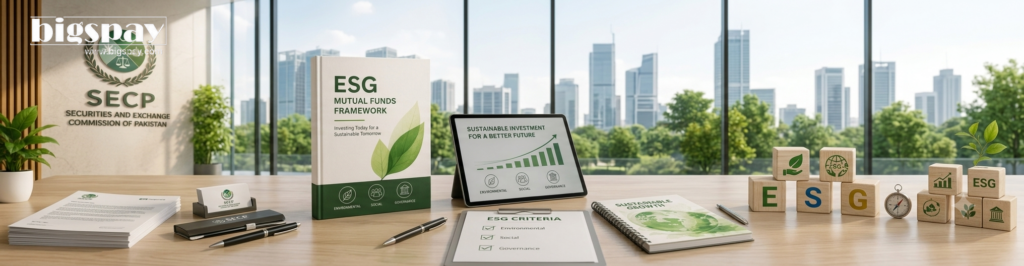
Pakistan’s capital market now has a formal rulebook for green investing. The Securities and Exchange Commission of Pakistan (SECP) has issued the country’s first ESG Mutual Funds Framework, allowing asset management companies (AMCs) to launch investment funds built specifically around environmental, social, and governance (ESG) standards with built-in safeguards against misleading “green” claims.
Key Takeaways
- What launched: Pakistan’s first ESG Mutual Funds Framework, issued by SECP
- Who can use it: Licensed Asset Management Companies (AMCs), regulated under SECP’s NBFC framework
- Minimum ESG allocation: At least 50% of a fund’s net assets must go into ESG-aligned investments
- Two fund types: Equity-based ESG funds and debt-based ESG funds
- Core goal: Channel investment toward sustainable businesses while preventing “greenwashing”
- Context: Part of a broader SECP sustainable finance agenda that includes the Pakistan Green Taxonomy, ESG Disclosure Guidelines, and the ESG Sustain platform
What the Framework Actually Does
The ESG Mutual Funds Framework gives Pakistani asset managers, for the first time, a formal regulatory pathway to launch funds explicitly marketed as sustainable or ESG-focused rather than leaving “green investing” claims informal and unregulated, as they have been until now.
The framework splits ESG funds into two categories:
- Equity-based ESG funds, which will primarily invest in companies included in the Pakistan Stock Exchange’s Sustainability Index and those aligned with SECP’s ESG Disclosure Guidelines
- Debt-based ESG funds, which will invest in green, social, sustainability, and sustainability-linked debt instruments, in line with Pakistan’s Green Taxonomy and Sustainable Finance Framework
Both fund types must meet the same core requirement: at least 50% of net assets allocated to ESG-compliant investments, backed by governance, disclosure, and independent assurance requirements designed to verify that ESG claims are real rather than marketing language.
Why the Threshold Matters and Why It Changed
When SECP first floated this idea via a concept paper in April 2026, the proposed minimum ESG allocation was 70% of fund assets a notably stricter bar than what was ultimately adopted. The finalized framework, issued in July, settled on a 50% minimum instead.
That’s a meaningful shift, and it says something about how SECP calibrated the rules after public consultation: a lower mandatory threshold gives asset managers more flexibility to build viable, diversified ESG products in a market where fully ESG-compliant, PSX-listed options are still relatively limited while the disclosure and assurance requirements are what’s actually meant to carry the anti-greenwashing weight, rather than the allocation percentage alone.
Why This Matters for Pakistan’s Capital Market
Sustainable investing isn’t a niche trend globally anymore more than $16 trillion in assets are now managed under sustainable investment strategies worldwide. Pakistan, despite being one of the world’s most climate-vulnerable countries, has until now lacked a structured, regulated product through which everyday investors could actually put money into ESG-screened investments with any regulatory backing.
This framework changes that in a few concrete ways:
- It creates the first SECP-regulated retail route into ESG investing in Pakistan, rather than leaving “sustainable” investment claims to informal, self-declared standards
- It ties fund eligibility to the PSX Sustainability Index, giving equity ESG funds an objective, market-based reference point rather than relying purely on each AMC’s internal scoring
- It links debt ESG funds to Pakistan’s Green Taxonomy, a classification system that defines what actually counts as an environmentally sustainable economic activity closing a definitional gap that previously made “green bond” claims hard to verify
- It builds on rather than exists in isolation from SECP’s broader ESG infrastructure, including ESG Disclosure Guidelines for listed companies, adoption of IFRS S1 and S2 sustainability reporting standards, and the ESG Sustain data platform
What This Means for Different Groups
For asset management companies: This opens a genuinely new product category, but one with real infrastructure requirements attached AMCs will need internal ESG research capability, reliable sustainability data sourcing, and disclosure systems in place before they can legally market a fund as “ESG.”
For listed companies: The framework creates a direct financial incentive to strengthen ESG practices and pursue inclusion in the PSX Sustainability Index, since that inclusion now determines eligibility for a whole category of investment capital that didn’t formally exist before.
For retail and institutional investors: For the first time, investors get a regulator-backed way to direct savings toward ESG-screened investments with disclosure and assurance requirements attached rather than relying on a fund’s own marketing language to determine whether it’s genuinely sustainable.
For Pakistan’s broader economy: SECP has framed the initiative as a tool to attract both domestic and international investment into the country’s sustainable economy relevant given how much global capital is now specifically mandated to flow only into ESG-labeled products.
Benefits of the New Framework
- Reduces greenwashing risk through mandatory disclosure, governance, and independent assurance requirements rather than self-certification
- Gives Pakistani companies a clear incentive to improve ESG practices in order to access a new pool of investment capital
- Aligns Pakistan’s capital market with global sustainable finance norms, potentially easing access to international ESG-mandated capital
- Diversifies the domestic mutual fund industry with a genuinely new product category, rather than a rebranding of existing funds
- Builds on existing SECP infrastructure (Green Taxonomy, IFRS S1/S2, ESG Sustain) instead of creating a standalone, disconnected rule
Frequently Asked Questions
What is SECP’s ESG Mutual Funds Framework?
It’s Pakistan’s first formal regulatory framework allowing asset management companies to launch mutual funds specifically focused on environmental, social, and governance (ESG) investments, with built-in rules to prevent misleading “green” claims.
What percentage of an ESG fund’s assets must be ESG-compliant?
At least 50% of net assets must be allocated to ESG-aligned investments, according to the finalized framework issued in July 2026.
What’s the difference between equity and debt ESG funds under this framework?
Equity-based ESG funds primarily invest in companies on the Pakistan Stock Exchange’s Sustainability Index, while debt-based ESG funds invest in green, social, and sustainability-linked debt instruments under Pakistan’s Green Taxonomy.
How does the framework prevent greenwashing?
Through mandatory governance standards, disclosure requirements, and independent assurance mechanisms designed to verify that a fund’s ESG claims are accurate rather than self-declared.
Was the ESG allocation threshold always 50%?
No. SECP’s original April 2026 concept paper proposed a 70% minimum ESG allocation; the finalized framework lowered this to 50% after public consultation.
Is the Pakistan Stock Exchange Sustainability Index already active?
Not fully. Until it is completely operational, equity ESG funds will rely partly on individual asset management companies’ internal ESG assessment methods.





Pingback: Pakistan Hits Record 43,559 New Company Registrations