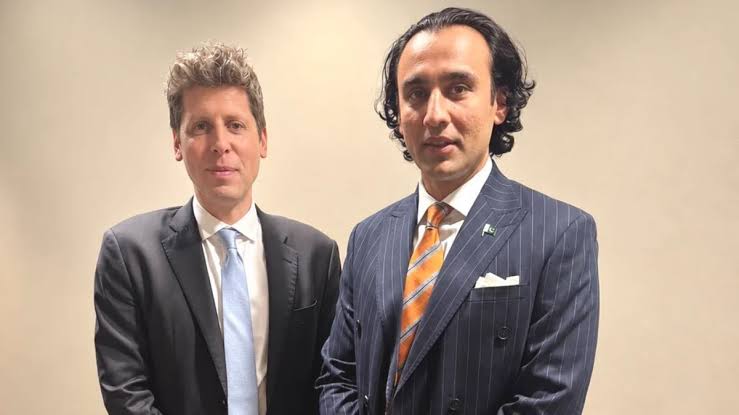
Pakistan’s growing digital potential has entered a broader global artificial intelligence conversation after Minister of State and Pakistan Virtual Assets Regulatory Authority (PVARA) Chairman Bilal Bin Saqib met OpenAI CEO Sam Altman on the sidelines of the United Nations General Assembly in New York.
The meeting focused on how Pakistan could use its young workforce, energy capacity and growing digital scale to participate more actively in the rapidly expanding global AI economy.
According to Saqib’s public post, discussions covered AI infrastructure, education, skills development, talent and opportunities for deeper engagement with OpenAI.
Importantly, no specific investment agreement, funding commitment or commercial partnership was announced following the meeting.
Table of Contents
Key Takeaways
- Meeting: Bilal Bin Saqib with Sam Altman
- Company: OpenAI
- Location: New York
- Occasion: 81st United Nations General Assembly
- Key topics: AI infrastructure, education, skills and talent
- Pakistan’s resources highlighted: Young talent, energy capacity and digital scale
- Potential focus: Deeper engagement with OpenAI
- Investment agreement announced: No
- Commercial commitment announced: No
Bilal Bin Saqib Meets Sam Altman
Bilal Bin Saqib, Minister of State and chairman of PVARA, met Sam Altman, CEO of OpenAI, during the UN General Assembly in New York.
Saqib said the conversation explored how Pakistan could turn its young talent, energy resources and digital capacity into a more meaningful role in the global AI economy.
The meeting places Pakistan’s technology ambitions in the context of a global discussion increasingly focused on AI infrastructure, talent, regulation and access to emerging technologies.
AI Infrastructure and Talent at the Centre of Talks
The discussion covered several areas that could shape Pakistan’s participation in the AI economy.
These included:
- AI infrastructure
- Education
- Skills development
- Technology talent
- Digital capacity
- Potential deeper engagement with OpenAI
For Pakistan, developing a skilled workforce is particularly relevant because AI adoption increasingly requires professionals with expertise in areas such as software engineering, data, machine learning and AI systems.
Pakistan Wants a Bigger Role in the Global AI Economy
The meeting comes as Pakistan increasingly discusses the possibility of moving beyond simply using AI technologies toward developing products, services and infrastructure around them.
Saqib has argued publicly that Pakistan should seek a more active position in the emerging AI economy by leveraging its young population and digital capabilities.
That approach could involve developing local talent, strengthening digital infrastructure and creating opportunities for Pakistani technology companies and professionals to participate in international markets.
No OpenAI Investment Deal Announced
Despite the attention surrounding the meeting, there is currently no announced OpenAI investment or commercial agreement with Pakistan.
Saqib’s public comments described discussions around potential engagement and Pakistan’s opportunities in AI, but did not announce a specific investment, funding package, product launch or formal commercial partnership.
This distinction is important as the meeting represents exploratory engagement, rather than a confirmed OpenAI investment in Pakistan.
Why AI Infrastructure Matters
AI development requires more than software and skilled workers.
Large-scale AI systems depend on computing infrastructure, data centres, connectivity and substantial amounts of electricity.
Pakistan’s available energy capacity was therefore among the resources highlighted in discussions about how the country could participate in the global AI economy.
The conversation comes as Pakistan is also examining opportunities linked to digital infrastructure and emerging technology industries.
Education and Skills Could Be Key
Another major part of the discussion was education and skills development.
Pakistan has a large young workforce, but participating in higher-value parts of the AI economy requires specialized skills and practical experience.
Training in areas such as AI engineering, machine learning, data science, cloud computing and related technologies could help Pakistani professionals compete for international opportunities.
The meeting therefore placed talent development alongside infrastructure as an important component of Pakistan’s AI ambitions.
From AI Users to AI Builders
The broader message from Pakistan’s recent technology discussions is that the country wants to move beyond being simply a consumer of emerging technologies.
The ambition is increasingly framed around becoming a participant in the development of AI systems, digital infrastructure and technology-based businesses.
This could create opportunities for Pakistani startups, software companies, freelancers, researchers and technology professionals if the necessary skills, infrastructure and investment environment develop.
AI and Tokenisation Enter Pakistan’s Global Technology Agenda
The meeting with Sam Altman also comes shortly after Saqib spoke at a UN forum about artificial intelligence and tokenisation.
At the Social Business, Youth and Technology Forum during the 81st UN General Assembly, Saqib discussed AI and tokenisation as technologies that could potentially expand financial inclusion in developing economies.
This places the OpenAI meeting within a broader push to position Pakistan in discussions around emerging digital technologies.
What the OpenAI Meeting Could Mean for Pakistan
The immediate outcome is primarily greater dialogue and visibility rather than a confirmed investment.
However, discussions with global technology leaders can create opportunities for future engagement in areas such as:
- AI education
- Developer skills
- Digital infrastructure
- Technology entrepreneurship
- Research
- AI applications
- International technology networks
Any future partnership would require separate discussions and formal announcements.
FAQs
Did Pakistan sign an agreement with OpenAI?
No specific investment, funding or commercial agreement was announced following the meeting between Bilal Bin Saqib and Sam Altman.
Who met OpenAI CEO Sam Altman?
Bilal Bin Saqib, Minister of State and chairman of the Pakistan Virtual Assets Regulatory Authority (PVARA), met Sam Altman in New York.
Where did the meeting take place?
The meeting took place on the sidelines of the 81st United Nations General Assembly in New York.
What did Pakistan and OpenAI discuss?
The discussion covered AI infrastructure, education, skills development, talent and opportunities for deeper engagement with OpenAI.
Why was Pakistan’s young talent discussed?
Pakistan has a large young workforce, and the discussion explored how this talent and the country’s digital capacity could contribute to the expanding global AI economy.
Did OpenAI announce an investment in Pakistan?
No. There was no publicly announced OpenAI investment or specific commercial commitment following the meeting.
What is Pakistan’s broader AI ambition?
Pakistan is increasingly discussing ways to participate more actively in the global AI economy through talent development, infrastructure, education, digital technologies and technology entrepreneurship.
Outlook
The meeting between Bilal Bin Saqib and Sam Altman puts Pakistan’s AI ambitions into a high-profile international technology conversation.
For now, the development is best understood as an initial engagement rather than a confirmed OpenAI investment or partnership. The discussions around infrastructure, education, skills and talent could nevertheless provide areas for future cooperation.
Pakistan’s ability to translate its young workforce and digital capacity into a larger role in the AI economy will ultimately depend on investment in skills, computing infrastructure, energy, research and technology businesses.