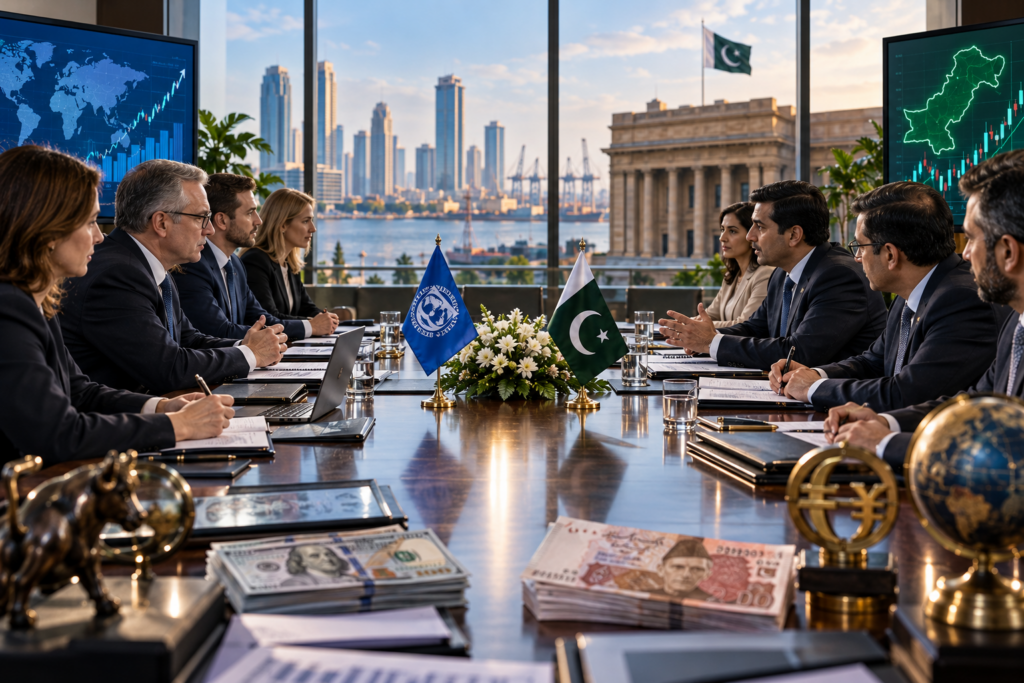
The International Monetary Fund (IMF) has begun discussions with the State Bank of Pakistan (SBP) in Karachi as part of the fourth review of Pakistan’s $7 billion Extended Fund Facility (EFF) programme.
The initial talks are focusing on key monetary and external-sector issues, including inflation, monetary policy and the exchange rate. The IMF mission is expected to move to Islamabad on September 28, where discussions will expand to the Ministry of Finance, Federal Board of Revenue (FBR) and other government departments.
The review is expected to assess Pakistan’s performance against programme targets through June 2026, while also examining fiscal policy, foreign exchange reserves, tax reforms and energy-sector reforms.
Table of Contents
Key Takeaways
- Programme: $7 billion Extended Fund Facility (EFF)
- Review: Fourth EFF review
- Initial talks: State Bank of Pakistan, Karachi
- Main SBP topics: Inflation, monetary policy and exchange rate
- Islamabad talks: Expected from September 28
- Institutions involved: Finance Ministry, FBR and other government departments
- Other areas: Foreign reserves, fiscal policy, tax reforms, power and gas reforms
- Additional exercise: Article IV consultation
- Review period: Programme performance through June 2026
- Expected duration: Around two weeks
IMF Starts Review With State Bank of Pakistan
The IMF review mission began its latest round of discussions with SBP officials in Karachi, starting with issues directly linked to Pakistan’s monetary and external sectors.
The discussions include inflation trends, monetary policy and exchange-rate developments, all of which are important components of Pakistan’s IMF programme.
The IMF’s existing programme documents have emphasized maintaining an appropriately tight and data-dependent monetary policy while allowing exchange-rate flexibility to act as a shock absorber.
Talks to Move to Islamabad on September 28
After the initial Karachi discussions with the central bank, the IMF mission is expected to move to Islamabad on September 28.
The Islamabad phase will involve talks with the Ministry of Finance, FBR and other government departments, broadening the review beyond monetary and exchange-rate issues.
This phase is expected to cover the government’s fiscal performance, tax collection, structural reforms and developments in the energy sector.
Inflation and Monetary Policy Under Review
Inflation and monetary policy are among the most important issues in the current discussions.
The SBP is responsible for maintaining price stability, while the IMF programme requires monetary policy to remain appropriately calibrated to inflation developments and expectations.
In its latest completed review, the IMF said the SBP should maintain an appropriately tight monetary policy stance and closely monitor potential second-round effects from price pressures.
The current review will assess developments since that previous assessment and examine whether Pakistan’s monetary policy remains consistent with programme objectives.
Exchange Rate and Foreign Reserves
The exchange rate and foreign exchange reserves are also central to the review.
The IMF has previously emphasized exchange-rate flexibility as an important shock absorber and called for continued efforts to deepen Pakistan’s interbank foreign exchange market.
Rebuilding reserve buffers is another key objective under the programme. The IMF’s latest Pakistan review documents have highlighted the importance of strengthening reserves and maintaining a functioning foreign exchange market.
Fiscal Policy and Tax Reforms
Once talks move to Islamabad, fiscal policy and taxation will become major parts of the review.
The IMF programme includes efforts to strengthen public finances and broaden the tax base. The government is also expected to discuss FBR performance, revenue collection and tax reforms with the IMF mission.
The IMF has previously identified tax administration and efforts to broaden the tax base as important elements of Pakistan’s fiscal reform agenda.
Power and Gas Sector Reforms
The review will also cover Pakistan’s power and gas sectors, areas that remain important to the country’s broader economic reform programme.
Energy-sector viability is a major IMF programme objective. Previous IMF reviews have emphasized timely tariff adjustments, cost recovery, reducing inefficiencies and preventing a renewed buildup of circular debt.
The latest review will therefore assess progress in implementing energy-sector measures alongside the country’s broader fiscal and structural reforms.
Article IV Consultation Also Underway
An Article IV consultation is also being conducted alongside the programme review.
The IMF’s Article IV process provides a broader assessment of a member country’s economic and financial policies and developments. According to the IMF’s country information, Pakistan’s previous Article IV Executive Board consultation was held on September 25, 2024.
The current exercise therefore adds a broader economic assessment to the ongoing EFF programme review.
Review Will Assess Performance Through June 2026
A key purpose of the fourth review is to assess Pakistan’s compliance with programme commitments and performance criteria through June 2026.
The IMF’s programme documents specify that completion of the fourth review scheduled for September 2026 requires observance of quantitative performance criteria for end-June 2026, alongside continuous performance criteria and indicative targets.
This makes the review an important checkpoint for Pakistan’s implementation of the EFF programme.
What Areas Will the IMF Examine?
The review covers a broad range of economic issues.
Monetary Policy
The IMF will examine inflation developments and the SBP’s monetary-policy stance.
Exchange Rate
Exchange-rate flexibility and developments in the foreign exchange market will remain under discussion.
Foreign Reserves
The IMF will assess progress in rebuilding Pakistan’s external reserve buffers.
Fiscal Policy
Government revenues, expenditures and the fiscal position will be reviewed against programme targets.
Tax Reforms
FBR performance and efforts to improve tax collection and broaden the tax base will be part of the Islamabad discussions.
Energy Reforms
Power and gas-sector reforms will be assessed, including measures related to financial sustainability and efficiency.
Why the Fourth Review Matters
The fourth review is an important checkpoint under Pakistan’s $7 billion EFF programme.
The IMF’s previous completed review in May 2026 resulted in an immediate disbursement of about $1.1 billion under the EFF, alongside approximately $220 million under the separate Resilience and Sustainability Facility (RSF).
The current review will determine how Pakistan’s performance against the latest set of programme commitments is assessed.
Two Weeks of Economic Discussions
The review process is expected to continue for approximately two weeks, covering both the SBP discussions in Karachi and the broader government-level talks in Islamabad.
The mission’s assessment will bring together monetary, fiscal, external-sector and structural issues rather than examining any single economic indicator in isolation.
The outcome will depend on the IMF’s assessment of Pakistan’s performance against the agreed programme targets and reform commitments.
FAQs
What is the IMF currently reviewing in Pakistan?
The IMF is conducting the fourth review of Pakistan’s $7 billion Extended Fund Facility programme, covering economic performance and progress against programme targets through June 2026.
What is the IMF discussing with the SBP?
Initial discussions with the State Bank of Pakistan are focusing on inflation, monetary policy and the exchange rate.
When will IMF talks move to Islamabad?
The IMF mission is expected to move to Islamabad on September 28, 2026, for discussions with the Ministry of Finance, FBR and other government departments.
What other issues will the IMF review?
The broader review will cover foreign exchange reserves, fiscal policy, tax reforms, monetary policy, and power and gas-sector reforms.
What is Pakistan’s IMF programme worth?
Pakistan’s current Extended Fund Facility is worth approximately $7 billion and was approved in September 2024.
What is an Article IV consultation?
An Article IV consultation is the IMF’s broader assessment of a member country’s economic and financial developments and policies. Pakistan’s previous Article IV Executive Board consultation was held in September 2024.
How long will the current IMF review take?
The review process is expected to continue for approximately two weeks, covering discussions with the SBP and government institutions.
What period will the IMF assess?
The fourth EFF review will assess Pakistan’s performance against programme targets through June 2026, including the relevant end-June performance criteria.
Outlook
The IMF’s latest review puts Pakistan’s inflation, monetary policy, exchange rate, fiscal position and structural reforms under close examination.
The initial Karachi discussions with the SBP will focus on monetary and external-sector issues, while the Islamabad phase is expected to broaden the review to taxation, public finances and energy-sector reforms.
The review is also significant because it combines the EFF assessment with an Article IV consultation, providing a broader examination of Pakistan’s economic policies and performance.