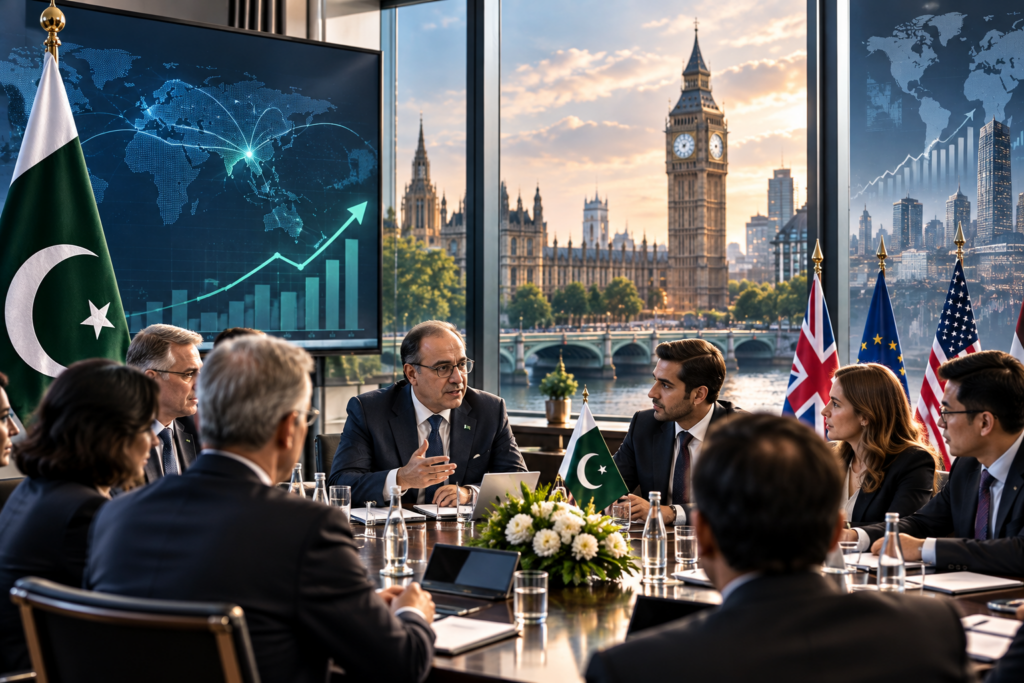
Pakistan’s investment story drew strong attention in London as 55 global investment funds engaged with the Pakistani delegation at the J.P. Morgan Emerging and Frontier Markets Opportunities Conference on September 18.
The investor engagement included multiple one-on-one meetings as well as a full investor session, with discussions taking place within a single day. The Pakistani delegation used the opportunity to present the country’s economic direction and highlight investment opportunities as the government seeks to move beyond stabilization toward broader economic growth.
Finance Minister Muhammad Aurangzeb told investors that Pakistan is now focusing on investment, exports, capital formation and private-sector-led growth, while continuing structural reforms and efforts to strengthen economic stability.
Table of Contents
Key Takeaways
- 55 global investment funds engaged with Pakistan’s delegation in London.
- Meetings were held at the J.P. Morgan Emerging and Frontier Markets Opportunities Conference.
- The engagement included one-on-one meetings and a full investor session.
- GDP growth recovered to 3.7% in FY26, according to the Finance Ministry.
- The fiscal deficit fell to 2.6% of GDP.
- Pakistan recorded a primary surplus for the third consecutive year.
- The government outlined six economic priorities for the next phase of growth.
- The agenda includes investment, exports, structural reforms, financial access and the digital economy.
55 Global Funds Meet Pakistan’s Delegation
The scale of investor participation made the London conference an important platform for Pakistan to communicate its economic priorities directly to international institutional investors.
According to the government, 55 global investment funds took part through individual meetings and a broader investor session. The discussions focused on Pakistan’s economic direction, investment opportunities and the sustainability of its economic transformation.
Amin Khowaja, J.P. Morgan Pakistan CEO and Country Head, was also present during the investor meetings.
Pakistan Shifts Focus From Stabilisation to Investment
Aurangzeb presented the government’s economic strategy as a transition from crisis management and stabilization toward a more investment-driven growth model.
The focus is increasingly being placed on:
- Higher investment
- Productivity improvements
- Export growth
- Capital formation
- Greater private-sector participation
- Expanded access to finance
- Structural reforms
The Finance Ministry said Pakistan’s immediate challenge over the past three years had been restoring macroeconomic stability and rebuilding economic credibility. The government now wants that stability to provide the foundation for longer-term growth.
Six Priorities Presented to Investors
The finance minister outlined six key priorities for Pakistan’s next phase of economic development.
1. Maintain Macroeconomic Stability
The government wants to make recent improvements in fiscal and external stability more durable while strengthening the economy’s ability to absorb future shocks.
2. Increase Productivity and Investment
Pakistan aims to move toward growth driven increasingly by productivity, investment and exports rather than short-term consumption.
3. Continue Structural Reforms
The government emphasized the need to maintain the pace of structural reforms as part of efforts to strengthen the economy and improve the environment for private-sector activity.
4. Move From Aid to Trade and Investment
Another major objective is to shift Pakistan’s external economic relationship from traditional aid dependence toward greater trade and investment flows.
5. Expand Access to Finance
The government also highlighted the importance of improving access to finance for individuals, businesses and productive sectors of the economy.
6. Prepare for the Digital Economy
Pakistan also wants to position itself for emerging areas of the digital economy, including digitalisation, blockchain and Web 3.0.
Pakistan Highlights Improving Economic Indicators
The government used recent economic indicators to support its investment narrative.
According to the figures presented by Finance Minister Aurangzeb, Pakistan’s GDP growth recovered to 3.7% in FY26, while the fiscal deficit declined to 2.6% of GDP.
Pakistan also recorded a primary surplus for the third consecutive year. The Finance Ministry described the fiscal deficit as a multi-year low.
These indicators were presented to investors as part of the government’s broader case that economic stabilization is creating a foundation for investment-led growth.
Why Global Investor Interest Matters
For Pakistan, attracting international institutional investors is not only about securing immediate investment.
Greater investor engagement can also provide access to international capital, partnerships and financing opportunities. It can help Pakistani policymakers and businesses communicate directly with global funds about reforms, market opportunities and the country’s longer-term economic direction.
The London meetings therefore provided a platform for Pakistan to explain how it intends to convert macroeconomic stabilization into investment, exports and private-sector growth.
From Economic Stabilisation to Capital Formation
The central message from the conference was that stabilization is being presented as a starting point rather than the final objective.
The government wants the next stage of economic development to involve greater capital formation, stronger productivity and increased private-sector participation.
That approach also places greater emphasis on expanding access to finance and developing new opportunities linked to the digital economy.
What This Could Mean for Pakistan’s Investment Story
The participation of 55 global funds gives Pakistan an opportunity to keep its economic reform agenda in front of international investors.
However, investor interest and actual investment commitments are different things. The conference demonstrates engagement and interest, while the eventual impact will depend on whether discussions translate into investment, business activity and longer-term capital flows.
For Pakistan, maintaining macroeconomic stability and continuing reforms will remain important to sustaining international investor engagement.
FAQs
How many global investment funds met Pakistan’s delegation in London?
A total of 55 global investment funds engaged with the Pakistani delegation at the J.P. Morgan Emerging and Frontier Markets Opportunities Conference.
Where did the investor meetings take place?
The meetings were held in London during the J.P. Morgan Emerging and Frontier Markets Opportunities Conference on September 18, 2026.
What did Muhammad Aurangzeb present to investors?
The finance minister presented Pakistan’s transition from economic stabilization toward investment, exports, capital formation and private-sector-led growth.
What was Pakistan’s GDP growth in FY26?
According to the figures presented by the Finance Ministry, Pakistan’s GDP growth recovered to 3.7% in FY26.
What happened to Pakistan’s fiscal deficit?
The fiscal deficit declined to 2.6% of GDP, which the Finance Ministry described as a multi-year low.
What are Pakistan’s six economic priorities?
The priorities include maintaining macroeconomic stability, increasing productivity and investment, continuing structural reforms, moving from aid toward trade and investment, expanding access to finance, and preparing for the digital economy.
Did Pakistan discuss blockchain and Web 3.0?
Yes. The government included blockchain and Web 3.0 within its broader focus on preparing Pakistan for the emerging digital economy.
Who from J.P. Morgan attended the meetings?
Amin Khowaja, J.P. Morgan Pakistan CEO and Country Head, attended the investor meetings.
Outlook
Pakistan’s engagement with 55 global investment funds in London gives the country another platform to present its economic reforms and investment opportunities to international capital managers.
The government’s message is increasingly centered on turning macroeconomic stability into investment, exports, productivity and private-sector-led growth. The extent to which this translates into new investment will depend on continued reforms, economic stability and investors’ assessment of opportunities in Pakistan.