
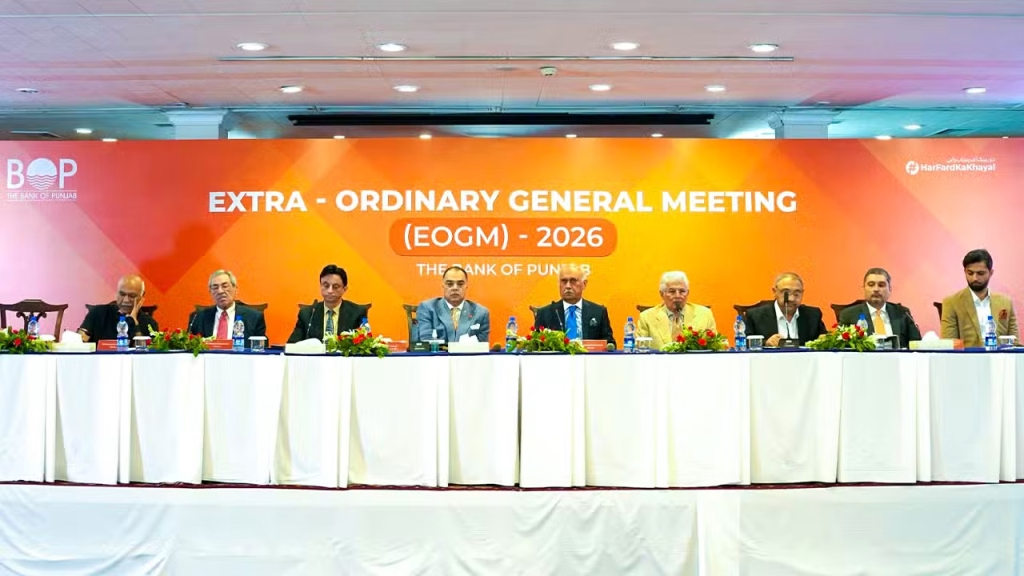
Shareholders of The Bank of Punjab (BOP) have unanimously approved an equity injection of up to Rs. 30 billion by the Government of Punjab, giving the bank additional capital to support balance-sheet expansion and growth across its major banking businesses.
The approval was granted at an Extraordinary General Meeting (EOGM) held on September 8, 2026. The capital will be raised through the issuance of ordinary shares to the provincial government outside a rights issue, subject to the required regulatory and statutory approvals.
Table of Contents
Key Takeaways
- Bank: The Bank of Punjab (BOP)
- Investor: Government of Punjab
- Approved Equity Injection: Up to Rs. 30 billion
- Approval Date: September 8, 2026
- Method: Issuance of ordinary shares outside a rights issue
- BOP President & CEO: Zafar Masud
- Purpose: Growth capital and balance-sheet expansion
- Target Areas: Corporate, commercial, SME, agriculture, housing, digital and Islamic banking
- Additional Opportunity: Proposed overseas wholesale banking unit
Shareholders Approve Rs. 30 Billion Equity Injection
BOP shareholders unanimously approved the proposed equity subscription by the Government of Punjab during the September 8 EOGM.
The injection will increase the bank’s equity base and provide additional capacity to expand its lending and deposit operations while remaining within applicable capital adequacy and leverage requirements.
BOP currently has Tier-1 capital of around Rs. 99.9 billion against total assets of Rs. 2.952 trillion, according to information released with the approval.
Capital to Support Balance-Sheet Growth
The additional equity is intended to give BOP greater capacity to mobilise deposits and deploy them into earning assets.
The bank plans to use the increased capital to support expansion across a broad range of businesses, including:
- Corporate banking
- Commercial banking
- SME financing
- Agriculture finance
- Housing finance
- Digital banking
- Islamic banking
BOP also expects the stronger capital position to support its proposed overseas wholesale banking unit.
Government Investment Will Be Issued in Phases
The Rs. 30 billion injection is expected to be completed in phases rather than through a single transaction.
Subject to regulatory approvals, BOP expects Rs. 15 billion to Rs. 20 billion of shares to be issued against cash subscriptions by December 31, 2026, with the remaining Rs. 10 billion to Rs. 15 billion expected by June 30, 2027.
No shares will be issued until the required statutory and regulatory conditions have been satisfied.
BOP Says Injection Is Growth Capital
BOP has described the proposed investment as growth capital rather than a recapitalisation required because of portfolio stress.
The bank said its government-related schemes amount to approximately Rs. 182 billion, representing about 18% of its portfolio, while more than 17% of that amount is covered by government guarantees. According to BOP, these schemes account for only around 3% of its total non-performing loans.
The bank said the new capital is intended to create capacity for profitable, risk-adjusted growth.
Government of Punjab’s Stake Will Increase
The new share issuance will also increase the Government of Punjab’s ownership in BOP.
The shares will be issued at the higher of Rs. 38.20 per share or the prevailing market price plus a 5% premium, according to the terms disclosed by the bank.
BOP said the Rs. 38.20 floor price was determined by independent valuer KPMG Taseer Hadi & Co. and represents a premium to the bank’s audited break-up value per share.
Following the full Rs. 30 billion injection at the floor price, the provincial government’s shareholding is expected to rise from 57.47% to 65.71%.
Potential Short-Term EPS Dilution
The additional share issuance could create some short-term pressure on earnings per share (EPS) and return on equity (ROE) if the new shares are counted before the capital is fully deployed.
However, BOP expects the additional business and earnings generated through the expanded capital base to offset the initial dilution over time.
The bank also said the injection would enhance book value per share rather than dilute it.
BOP Seeks Greater Competition With Larger Banks
The additional capital could strengthen BOP’s ability to compete with larger commercial banks, particularly in attracting low-cost deposits.
A stronger capital base gives banks greater flexibility to expand their earning assets while maintaining required regulatory capital ratios.
For BOP, the strategy is to combine additional equity with deposit mobilisation and growth across multiple business segments.
Stronger Focus on Multiple Banking Segments
The capital injection is expected to support BOP’s expansion across both traditional and emerging areas of banking.
Its growth strategy includes corporate and commercial lending, SME financing, agriculture, housing, digital banking and Islamic banking.
This diversified approach could allow the bank to expand its customer base while reducing reliance on a single segment of the market.
Zafar Masud Highlights Growth Strategy
BOP President and CEO Zafar Masud described the transaction as growth capital intended to create capacity for the bank’s future expansion.
He said the bank is seeking to build the capital and operational capacity needed to scale its business while maintaining appropriate risk, pricing and profitability standards.
The bank has also stressed that government-related business will continue to be evaluated under its normal credit and risk-management framework.
Why This Matters for BOP
The approval is significant because the additional capital can provide BOP with greater room to expand its balance sheet.
A stronger equity base can help the bank:
- Mobilise a larger deposit base
- Increase lending capacity
- Expand SME and agricultural financing
- Grow corporate and commercial banking
- Develop digital banking services
- Expand Islamic banking
- Pursue its proposed overseas wholesale banking operations
- Compete more effectively with larger banks
The impact will ultimately depend on how quickly the new capital is deployed into profitable and risk-adjusted business.
What Happens Next?
BOP will proceed with the share issuance after obtaining all required regulatory and statutory approvals.
The first phase of the subscription is expected by the end of December 2026, followed by the remaining amount by June 2027, subject to the applicable approvals and conditions.
The bank will then look to deploy the additional capital across its targeted business segments and strengthen its capacity for long-term growth.
FAQs
How much capital has BOP approved from the Government of Punjab?
BOP shareholders have approved an equity injection of up to Rs. 30 billion by the Government of Punjab.
When did BOP shareholders approve the capital injection?
The approval was granted at an Extraordinary General Meeting on September 8, 2026.
How will the Punjab government invest in BOP?
The investment will be made through the issuance of ordinary shares outside a rights issue, subject to regulatory and statutory approvals.
What will BOP use the additional capital for?
The bank plans to support growth in corporate, commercial, SME, agriculture, housing, digital and Islamic banking, as well as its proposed overseas wholesale banking unit.
Will the entire Rs. 30 billion be injected at once?
No. BOP expects the investment to be completed in phases, with Rs. 15 billion to Rs. 20 billion expected by December 31, 2026 and the remaining Rs. 10 billion to Rs. 15 billion by June 30, 2027, subject to approvals.
Will the Punjab government’s ownership in BOP increase?
Yes. Following a full Rs. 30 billion injection at the stated floor price, the government’s shareholding is expected to increase from 57.47% to 65.71%.
Is the capital injection a bailout of BOP?
BOP has characterized the transaction as growth capital, saying it is intended to expand the bank’s capacity rather than address portfolio stress.