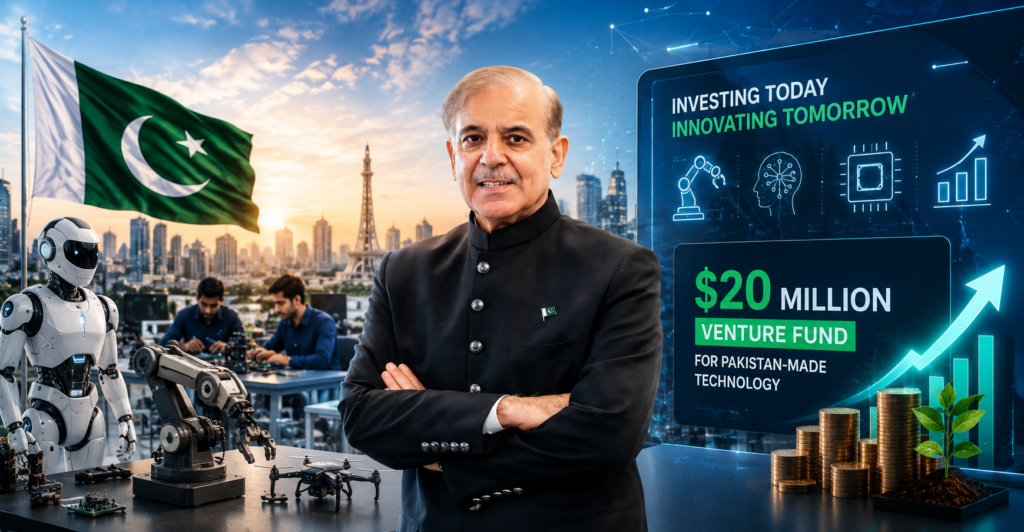
Pakistan just laid out its most concrete bet yet on becoming a serious player in robotics and autonomous systems. At the inaugural Indus RAS – Robotics and Autonomous Systems Expo 2026 in Islamabad, Prime Minister Shehbaz Sharif unveiled two landmark initiatives: the Spark and Elevate Program, designed to turn homegrown research into globally competitive technology enterprises, and the Pakistan Venture Fund, launched with an initial commitment of $20 million to catalyze investment in the country’s technology ecosystem.
Table of Contents
Key Takeaways
- Venue and occasion: Indus RAS – Robotics and Autonomous Systems Expo 2026, Islamabad
- New venture fund: Pakistan Venture Fund, launched with an initial $20 million commitment
- New program: Spark and Elevate, aimed at converting research into world-class technologies, competitive enterprises, and high-value jobs
- Attendees: PM Shehbaz Sharif and Chief of Defence Forces/Chief of Army Staff Field Marshal Syed Asim Munir
- Also present: IT Minister Shaza Fatima Khawaja, federal ministers, industrialists, entrepreneurs, foreign delegates, and students
- Defence context cited: Pakistan’s drones are now more than 60% indigenously developed
- Stated priority sectors: Agriculture, disaster response, underserved communities, farmers, women, and startups
- Also emphasized: The need for a regulatory and ethical framework to keep autonomous systems safe, transparent, and responsibly deployed
What Was Actually Announced
Speaking at the Expo’s inaugural ceremony, PM Shehbaz Sharif called for the creation of a unified national innovation ecosystem, urging universities, research and development centers, startups, industries, and farmers to collaborate under a single national innovation framework one where, in his words, the knowledge behind emerging technologies is “indigenous, owned, and continuously advanced in Pakistan.”
He then announced what he described as two landmark initiatives:
1. The Spark and Elevate Program, intended to transform Pakistan’s research output into world-class technologies, globally competitive enterprises, and high-productivity jobs effectively a bridge program designed to help ideas move from the lab or research center into commercially viable products and companies.
2. The Pakistan Venture Fund, launched with an initial commitment of $20 million, intended to catalyze investment in Pakistan’s broader technology ecosystem and provide financial support directly to technology startups working to commercialize research.
Why Robotics and Autonomous Systems, Specifically
PM Shehbaz framed the push toward robotics and autonomous systems as something bigger than a single technology sector describing it as reflecting the aspirations of “a nation of about 250 million resilient people determined to re-imagine, to compete, and to build a better future.” He specifically highlighted practical, near-term applications relevant to Pakistan’s economic and social priorities:
- Agriculture: Robotics and autonomous systems helping detect crop disease, optimize water and fertilizer use, and improve overall productivity directly relevant to a country where agriculture remains a major employer and economic sector.
- Disaster response: Faster reach for rescue teams into affected areas, and improved relief operation efficiency — relevant given Pakistan’s recurring exposure to floods, droughts, wildfires, and landslides.
- Inclusive benefit: PM Shehbaz specifically said robotics and autonomous systems must empower farmers, startups, women, and underserved communities, not just larger urban tech firms.
The Defense and Security Angle
The event carried a visible defense dimension, underscored by the attendance of Field Marshal Syed Asim Munir, Chief of Defence Forces and Chief of Army Staff, alongside the Prime Minister. PM Shehbaz specifically praised Pakistan’s armed forces for progress in indigenous defense capabilities, noting that more than 60% of Pakistan’s drones are now locally developed a milestone he said would strengthen the country’s security architecture, “make our defence more impregnable,” and improve resilience against emerging and future threats.
This defense context isn’t incidental: Pakistan’s military has previously used unmanned combat aerial vehicles (UCAVs) during its May 2025 confrontation with India, and the country has increasingly prioritized domestic drone manufacturing partly in response to recurring climate-related disaster risks alongside security considerations.
What the IT Minister Added
IT Minister Shaza Fatima Khawaja, addressing the Expo, said countries that lead in emerging technologies would be the ones shaping the global economy of the future, and stated that Pakistan is determined to build complete value chains in robotics language suggesting the government’s ambitions extend beyond isolated pilot projects toward building a full domestic ecosystem, from components and research through to commercial products.
Why This Matters
- It’s a rare government-led attempt to fund technology commercialization directly, not just policy. While Pakistan has rolled out numerous digital finance and regulatory reforms in 2026 from SECP’s ESG framework to SBP’s payments modernization the Pakistan Venture Fund represents a more direct capital injection specifically aimed at technology startups and research commercialization.
- It connects Pakistan’s civilian innovation push to a tangible defense achievement. The more-than-60% drone indigenization figure gives the broader robotics ecosystem push a concrete, already-demonstrated proof point, rather than existing purely as aspirational policy language.
- It targets a genuine structural gap identified in Pakistan’s broader tech and fintech landscape. As covered in analyses of challenges facing Pakistan’s fintech and technology sectors, a persistent shortage of follow-on investment capital has limited how far promising Pakistani technology ventures can scale a $20 million dedicated venture fund is a direct, if still modest, response to that specific gap.
- It signals continued momentum in Pakistan’s broader digital economy narrative for 2026 arriving alongside record freelancer export earnings, a strong ICT export performance, and a series of digital finance modernization initiatives, together reinforcing a government-wide emphasis on technology as an economic growth driver.
Frequently Asked Questions
What did PM Shehbaz Sharif announce at the Indus RAS Expo 2026?
Two landmark initiatives: the Spark and Elevate Program, aimed at turning research into globally competitive technology enterprises, and the Pakistan Venture Fund, launched with an initial $20 million commitment to invest in Pakistan’s technology ecosystem.
What is the Pakistan Venture Fund?
A newly established fund with an initial $20 million commitment, intended to catalyze investment in Pakistan’s technology sector and provide financial support to startups commercializing research.
What is the Spark and Elevate Program?
A government initiative designed to help transform Pakistan’s research output into world-class technologies, globally competitive enterprises, and high-productivity jobs.
What sectors did the Prime Minister highlight as priorities for robotics adoption?
Agriculture, disaster response, and inclusive benefit for farmers, startups, women, and underserved communities.
Was there a defense angle to this announcement?
Yes. Field Marshal Syed Asim Munir attended the event, and PM Shehbaz highlighted that more than 60% of Pakistan’s drones are now indigenously developed, framing this as strengthening national security architecture.
Who else spoke at the event?
IT Minister Shaza Fatima Khawaja, who said countries leading in emerging technologies will shape the future global economy and that Pakistan aims to build complete robotics value chains domestically.